
Qingshe Twisted Painting:
From Wartime Ingenuity to Artistic Marvel

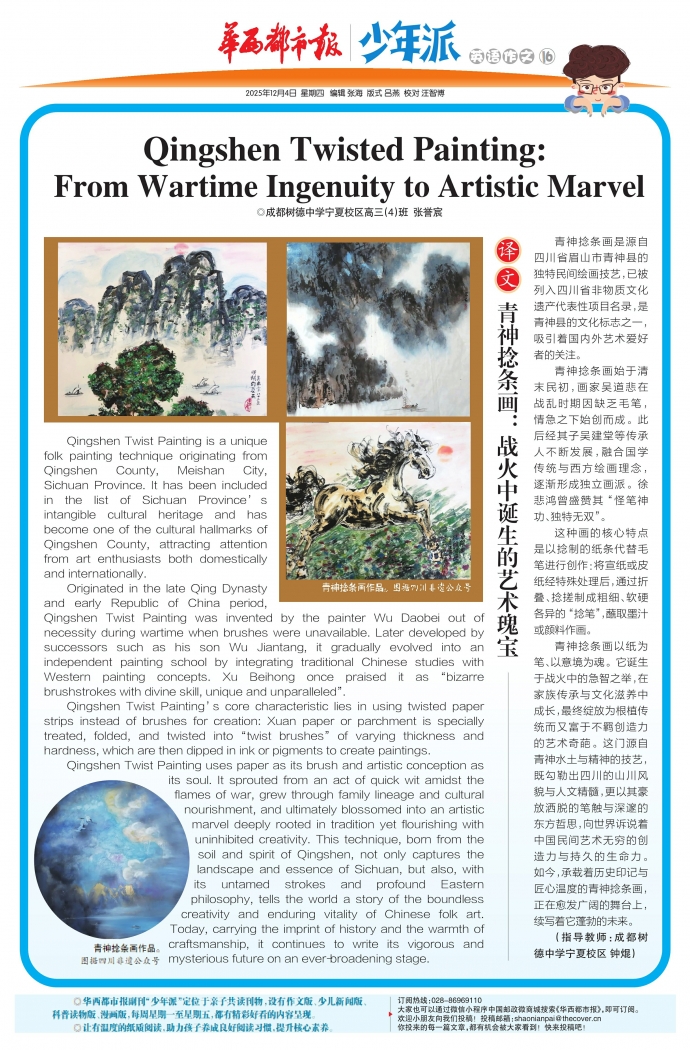
青神捻条画作品。图据四川非遗公众号

青神捻条画作品。图据四川非遗公众号


◎成都树德中学宁夏校区高三(4)班 张誉宸
Qingshen Twist Painting is a unique folk painting technique originating from Qingshen County, Meishan City, Sichuan Province. It has been included in the list of Sichuan Province’s intangible cultural heritage and has become one of the cultural hallmarks of Qingshen County, attracting attention from art enthusiasts both domestically and internationally.
Originated in the late Qing Dynasty and early Republic of China period, Qingshen Twist Painting was invented by the painter Wu Daobei out of necessity during wartime when brushes were unavailable. Later developed by successors such as his son Wu Jiantang, it gradually evolved into an independent painting school by integrating traditional Chinese studies with Western painting concepts. Xu Beihong once praised it as “bizarre brushstrokes with divine skill, unique and unparalleled”.
Qingshen Twist Painting’s core characteristic lies in using twisted paper strips instead of brushes for creation: Xuan paper or parchment is specially treated, folded, and twisted into“twist brushes”of varying thickness and hardness, which are then dipped in ink or pigments to create paintings.
Qingshen Twist Painting uses paper as its brush and artistic conception as its soul. It sprouted from an act of quick wit amidst the
flames of war, grew through family lineage and cultural nourishment, and ultimately blossomed into an artistic marvel deeply rooted in tradition yet flourishing with uninhibited creativity. This technique, born from the soil and spirit of Qingshen, not only captures thelandscape and essence of Sichuan, but also, with its untamed strokes and profound Eastern philosophy, tells the world a story of the boundless creativity and enduring vitality of Chinese folk art. Today, carrying the imprint of history and the warmth of craftsmanship, it continues to write its vigorous and mysterious future on an ever-broadening stage
.译文青神捻条画:战火中诞生的艺术瑰宝
青神捻条画是源自四川省眉山市青神县的独特民间绘画技艺,已被列入四川省非物质文化遗产代表性项目名录,是青神县的文化标志之一,吸引着国内外艺术爱好者的关注。
青神捻条画始于清末民初,画家吴道悲在战乱时期因缺乏毛笔,情急之下始创而成。此后经其子吴建堂等传承人不断发展,融合国学传统与西方绘画理念,逐渐形成独立画派。徐悲鸿曾盛赞其“怪笔神功、独特无双”。
这种画的核心特点是以捻制的纸条代替毛笔进行创作:将宣纸或皮纸经特殊处理后,通过折叠、捻搓制成粗细、软硬各异的“捻笔”,蘸取墨汁或颜料作画。
青神捻条画以纸为笔、以意境为魂。它诞生于战火中的急智之举,在家族传承与文化滋养中成长,最终绽放为根植传统而又富于不羁创造力的艺术奇葩。这门源自青神水土与精神的技艺,既勾勒出四川的山川风貌与人文精髓,更以其豪放洒脱的笔触与深邃的东方哲思,向世界诉说着中国民间艺术无穷的创造力与持久的生命力。如今,承载着历史印记与匠心温度的青神捻条画,正在愈发广阔的舞台上,续写着它蓬勃的未来。
(指导教师:成都树德中学宁夏校区钟焜)